


Game reference
D Roulette
A live roulette reference listed in the supplied catalogue.
Provider named in the source catalogue: SA Gaming.
Source: Jackpotter game catalogue.
Read the source version’s current rules. This reference does not establish availability, game configuration or payout terms for another service.
Return to the game collection →Reading a live table before the first bet
Live-streamed tables present physical cards, a wheel or tiles through a camera and a dealing surface, and the interface records what happened. That is different from RNG or virtual games, where software generates each outcome and no dealer is involved. For Indian players, streamed tables sit beside the slots, Teen Patti, Andar Bahar, Rummy and cricket betting in the source description of FUN88, and balances are held in INR, with UPI and Paytm among the stated deposit routes. Mobile-first play means the same table should stay legible on a phone, which is why layout matters as much as the game name.
The sensible order of reading is layout, settlement, then optional bets. A roulette grid tells you whether a single zero or a zero and double zero are present. A blackjack felt tells you where insurance, double and split boxes sit. A baccarat layout tells you which of three boxes a wager goes to, and whether side bets run along the top. None of these details are universal. Each table publishes its own limits, commission and permitted actions, and those printed conditions override anything a general guide says.
Catalogue labels are worth treating lightly. External listings show official artwork for titles such as 100 Teen Patti, Andar Bahar, Blackjack and D Roulette, while our own catalogue separately records Rich88, KA Gaming, Smartbet and SA Gaming behind those names. That is a record of labels, not a statement of what any table contains. The rules you meet on the felt may differ from any published variant, so the table’s own information panel is the authority.
One further comparison is useful because it is often confused with live dealing. A poker site describes free Texas Hold’em, Omaha and social poker played with virtual chips for amusement only, restricted to adults aged 21 and above, with no real-money gambling or prizes. That is a different structure from a table where wagers carry value. Keeping the two apart prevents assumptions about chips, stakes or eligibility from crossing over.
Roulette layouts and where a chip actually lands
Roulette is a single outcome resolved on a numbered wheel. The important differences are structural. A single-zero wheel carries one green zero; a double-zero wheel carries a zero and a double zero, and the extra pocket changes the relationship between the numbers covered and the total pockets. Nothing about the artwork of a roulette title tells you which layout it uses. The felt does. Count the zero positions before choosing anything.
The grid is read as a set of overlapping bets. A straight-up wager covers one number. A split sits on the line between two adjacent numbers. A street covers a row of three, a corner the intersection of four, and a line — also called a double street — covers two adjacent rows of three, so six numbers in total, not twelve. Outside the grid, red or black, odd or even and high or low each cover eighteen numbers on a single-zero wheel, which leaves the zero uncovered. Columns and dozens cover twelve numbers apiece.
A worked layout example
Suppose a table shows a single green zero and dozen boxes labelled 1st 12, 2nd 12 and 3rd 12. A player places one unit on the 2nd 12 and one unit as a corner covering four specific numbers inside that same dozen. The ball settles on one of those four numbers. The corner wins, and because it sits inside the second dozen, the dozen wager covers the same pocket. Had the ball settled on a number in the 3rd 12, both wagers would have lost together. Two chips can therefore move as one on some outcomes and diverge on others, and that overlap is the practical point of reading the grid.
On a double-zero layout the same exercise gains a pocket that settles neither wager. Coverage statements like “eighteen numbers” must be checked against the wheel in front of you. Some tables also offer neighbour bets or call bets placed on a racetrack, defined by the wheel’s physical number order rather than the grid. Treat their presence and permitted stake as table-specific. If an area is greyed out, the table is saying the action is unavailable in that round.
Roulette also rewards patience about rhythm. A round closes, the presenter clears the layout, the balance updates, and the next round opens. On mobile the interface may compress the grid into a scrollable panel and hide the outside boxes. If the layout is not fully visible, the table is not fully read.
Blackjack totals, soft hands and decision order
Blackjack compares hand totals against a dealer’s hand, with an ace counting as eleven or one. A hand holding an ace counted as eleven is soft, because the ace can fall to one without the hand breaking. A hand without that flexibility is hard. Ace, five and ten totals sixteen, because counting the ace as eleven would give twenty-six and bust. Recognising the moment a hand turns hard is the core skill, and it explains why two hands showing similar visible cards can behave very differently.
Totals beyond twenty-one bust immediately. Player actions are table-specific. Hit takes another card, stand keeps the total, double increases the wager once in exchange for a single further card, split separates a pair into two hands with an additional wager, and surrender, where offered, ends the hand for a partial return. Insurance appears when the dealer shows an ace and is a separate side wager with its own conditions. The number of decks, whether the dealer stands or hits on soft seventeen, and whether doubling after a split is allowed all belong to the table, not to the game name.
A worked hand example
Consider a player dealt ace and five, a soft sixteen. Taking a ten gives a hard sixteen, because the ace now counts as one: 1 + 5 + 10 = 16. A further ten would bust. On a table that permits doubling, the same starting hand might have been handled differently, but the availability of that action is printed on the felt and is not universal. The correct reading of soft sixteen depends on the table’s permitted actions and the dealer’s upcard, and the outcome of any single round is never certain.
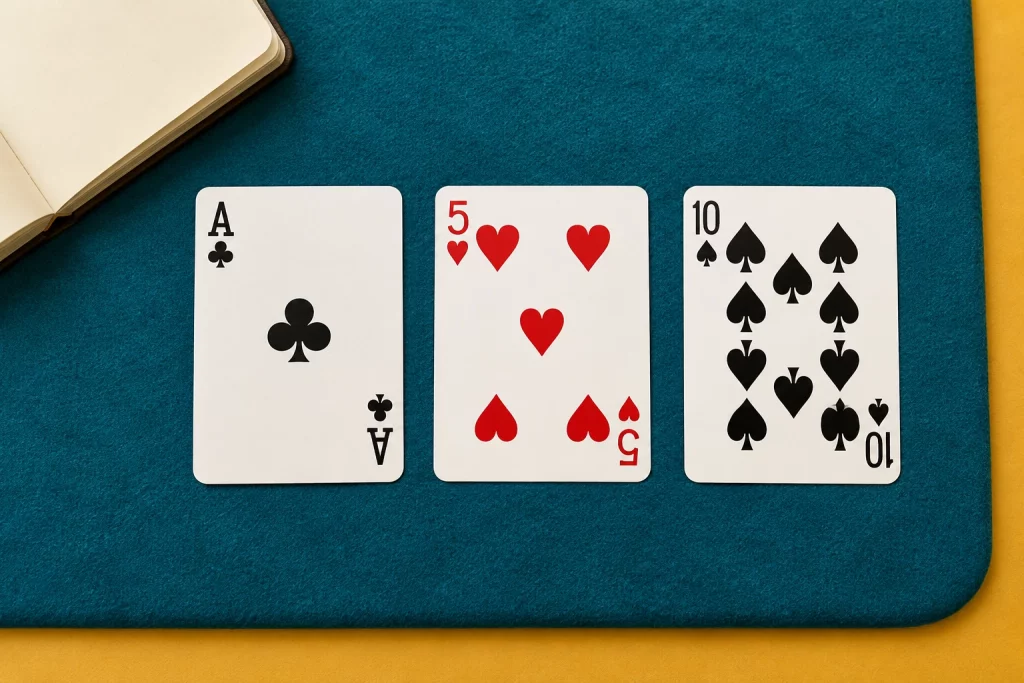
Split hands introduce their own bookkeeping. A pair of eights split into two hands may receive different cards, and some tables restrict resplitting or restrict doubling on the resulting hands. When a split creates a hand containing an ace and a ten, most tables treat it as twenty-one rather than a natural blackjack, but that distinction is table-specific and settles differently. Whether a natural blackjack is settled before or after the dealer acts is another table-level rule.
Decision order matters in live play. Where a table seats several players, the interface prompts each position in turn, and the round cannot move until every hand is resolved. Watching a recorded round shows this sequence clearly, which is why replays are more instructive than isolated screenshots. For a broader view of the site, the FUN88 Casino Information describes the broader game categories.
Baccarat hand labels, third-card rules and a round comparison
Baccarat looks complicated and is mostly administrative. Player and Banker are labels for two hands, not descriptions of who is dealing. A wager on Player wins if the Player hand is closer to nine; a wager on Banker wins if the Banker hand is closer. Both hands are dealt according to fixed drawing rules, and the player makes no decisions after placing the wager. Totals use the last digit only: eight plus seven is fifteen, which counts as five.
The third-card step is where tables diverge. Whether either hand draws depends on the starting totals and, on some tables, on the value of the card drawn to the opposing hand. These steps are predetermined, not choices, and the exact sequence must come from the rule panel on that table. Commission on Banker wins, the treatment of a Tie, and side bets such as pairs run alongside and differ by table. Read the panel before assuming any sequence.
Comparing one recorded round across three tables
The clearest way to see how much is table-specific is to line up the same kind of round from each game and note what the recording actually shows.
| Element observed | Roulette round | Blackjack round | Baccarat round |
|---|---|---|---|
| Player decision in the round | Wager placement only | Hit, stand, double, split or surrender as permitted | Wager placement only |
| Where the rule is printed | Wheel pockets and grid | Felt actions and dealer rule | Third-card panel and commission note |
| What a replay clarifies | Which bets shared the winning pocket | Order of prompts and soft-to-hard change | Whether a third card was drawn and why |
A roulette replay shows a single event and its overlapping bet coverage. A blackjack replay shows a sequence of choices, including a hand that became hard after a draw. A baccarat replay shows a scripted draw in which a third card either appears or does not, and the rule panel explains the reason. The same question — did my wager win — has three different mechanisms behind it.
Related Indian card and tile games reward the same habit of reading rules before play, though they are not all comparison games. Teen Patti compares three-card hands; Andar Bahar matches a target rank across alternating piles, with version-specific deal rules; Rummy groups cards into sequences and sets, with version-specific jokers, declaration and scoring. Each carries the same lesson: version-specific rules govern settlement, and the table or game panel outranks any guide, including this one.
Play is for adults aged 18 and over, and terms apply to any promotion. When a rule looks ambiguous, confirm it on the table’s own information panel.