
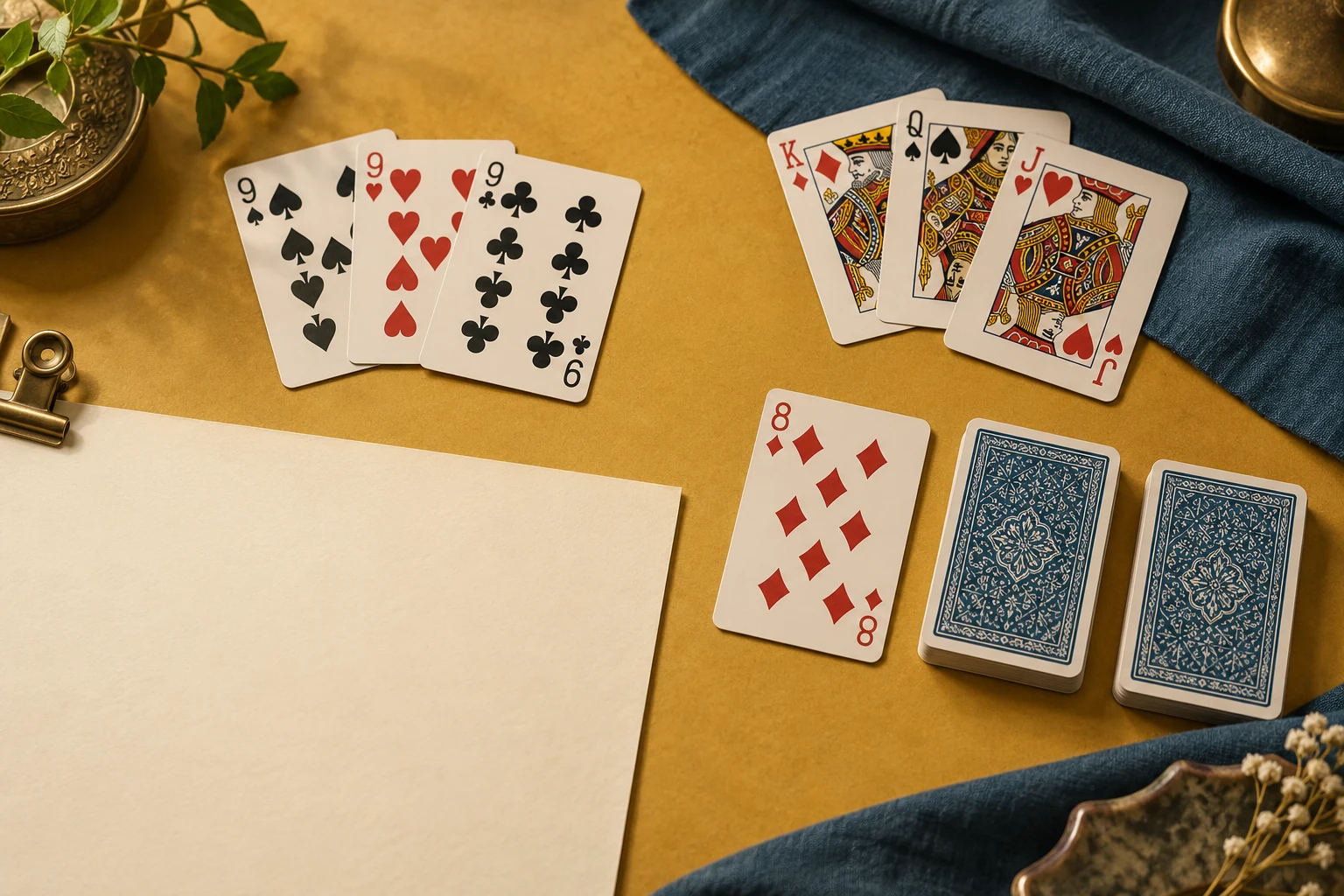

Game reference
Andar Bahar
A matching-card game reference; check the rules of the named version.
Provider named in the source catalogue: KA Gaming.
Source: Jackpotter game catalogue.
Read the source version’s current rules. This reference does not establish availability, game configuration or payout terms for another service.
Return to the game collection →Teen Patti: Comparing Three Cards
Teen Patti is a comparison game. Each player receives three cards, and the hand is settled by ranking those cards against the others. There is no shared board and no opportunity to improve across streets. That single structural fact explains most of the rhythm: decisions are short, information is limited, and the betting round carries the game’s character. FUN88 lists Teen Patti among its Indian card offerings alongside slots, live casino tables, rummy and cricket betting, with balances held in INR.
Hand categories are usually described in broad tiers. A trail is three cards of the same rank. A sequence is three cards that run consecutively, and a colour sequence keeps them in one suit. A pair is two cards of one rank plus an unconnected third. Below those sit high-card hands, compared by rank and then by suit where a version requires it. Read the table’s stated hierarchy and tie rules before comparing hands.
Ace treatment is another section to read carefully, and claims that A-K-Q always forms a sequence do not travel safely across variants. If a rules panel is available, look for how aces sit in sequences, whether a colour sequence outranks an ordinary one, and how identical ranks are separated. Those answers define a version more than any general description, because they decide the hands that occur most often at showdown.
A worked comparison
Suppose three players show their cards. Player one holds 9, 10 and Jack of hearts. Player two holds three eights. Player three holds two Kings and a four. On the common reading, player three has a pair, player two has a trail, and player one has a colour sequence. Under the stipulated hierarchy of trail above colour sequence above pair, player two wins. The example is simple, but it shows why reading the hierarchy first prevents most disputes about a result.
Betting structure deserves the same care. Teen Patti often distinguishes blind and seen players, who bet at different rates. Versions differ on the ratio, how many blind rounds are permitted, and what a side-show or compare request costs. These are not cosmetic details; they change the risk profile of a hand, and the rule panel should define the permitted stakes. The practical point is that Teen Patti rewards pricing uncertainty over three hidden cards, and a clear reading of the variant matters more than memorised hand charts. Readers who want the wider platform context can review the FUN88 Casino Information before choosing a format.
Andar Bahar: Target Rank and Deal Flow
Andar Bahar works on a different principle. A target card is revealed first, and the dealer then places cards alternately into two piles, Andar and Bahar, until a card matching the target’s rank appears. The pile that receives the match is the winning side. There is no hand to assemble and no decision about which cards to keep. The player’s choice is which side to back, and in many versions that choice is made once the target is known. The tension comes from the alternating reveal rather than from skill across several decision points.
Deal conditions are where versions diverge. Some tables deal the first card to Andar, others to Bahar. Side bets on the position of the match, the number of cards dealt, or the target appearing within a set number of deals are common additions, each with its own terms. Because these conditions are predetermined, the game is one of selection rather than ongoing judgement. Read the table’s panel before backing a side, since the order of dealing shapes how quickly a round ends.
A worked target-rank example
Imagine the target is the 7 of clubs. The dealer places a 2 of diamonds on Bahar, a Queen of hearts on Andar, a 9 of spades on Bahar, and a 7 of hearts on Andar. Because a seven has appeared in the Andar pile, Andar is the winning side under the common reading. Had the same seven landed on Bahar, Bahar would win. Only rank matters to the match; the suits of the intervening cards are irrelevant.
Rummy: Sequences, Sets and Valid Declarations
Rummy asks for something the other two formats do not: construction. A player holds a hand and draws and discards in turn, aiming to arrange the cards into valid groups. The two group types are the sequence and the set. A sequence is three or more consecutive cards of the same suit. A set is three or more cards of the same rank in different suits. A hand is declared when its groups satisfy the rule set, and most versions require at least one sequence, often one pure sequence without a joker standing in.
The joker is where rummy becomes version-specific. There are printed jokers and, in many Indian variants, a designated wild joker rank for the deal. A joker can substitute for a missing card in a sequence or set, but how many jokers a group may contain, and which cards count as jokers at all vary between variants. No single answer applies to every rummy table, and a player carrying assumptions from one variant into another will misread a valid hand as invalid or the reverse.
Declaration is the moment of truth. A player who believes the hand is complete places it down, and the groups are checked against the rules. Scoring for a failed declaration is version-specific. Common approaches penalise unmatched cards, but the values assigned to face cards, jokers and aces are not uniform, and some variants impose fixed penalties for certain mistakes. Read the specific table’s scoring schedule rather than rely on a remembered figure.
A worked grouping example
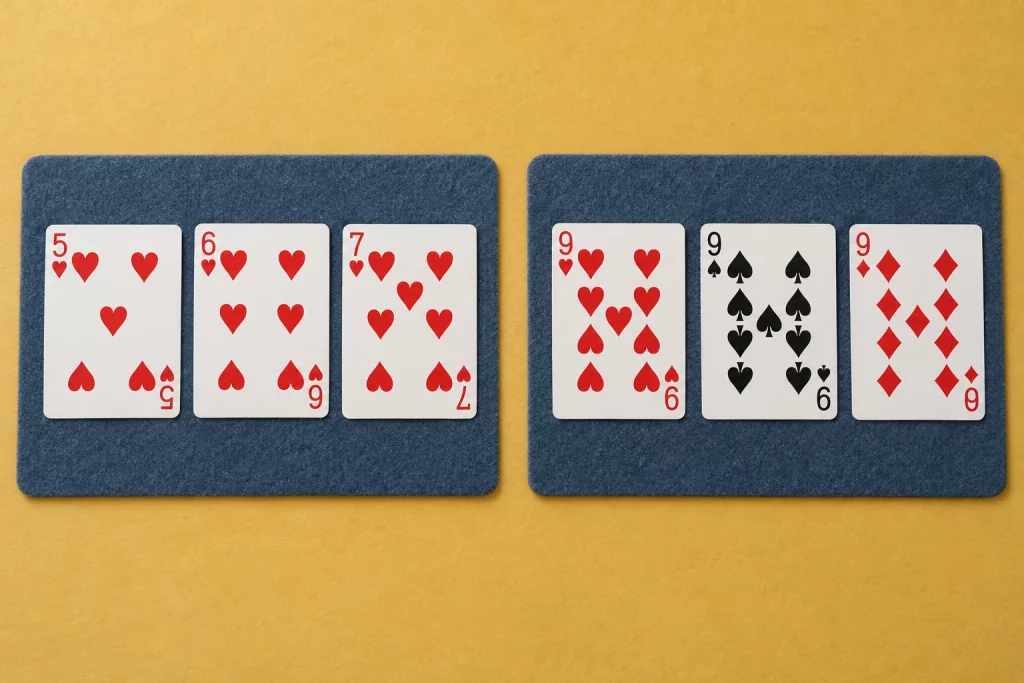
Take a hand containing 5, 6 and 7 of hearts, plus 9 of hearts, 9 of spades and 9 of diamonds, together with other cards. The three hearts form a pure sequence; the three nines form a set in three different suits. Each card appears in one group only, so no single card is doing double duty. How the leftover cards are treated depends on the version. If the table requires more sequences than this hand provides, it falls short regardless of the set. These six cards illustrate groups rather than a complete valid thirteen-card declaration; other cards and requirements still matter. The same grouping produces different verdicts under different rule sets, which is why the exercise must be done against the table you are actually playing rather than from memory.
Rummy also rewards attention to discards. A card you need may be visible in the open pile, and choosing between the open and closed piles is a genuine decision. That is a different kind of thinking from Teen Patti’s hidden-card pricing or Andar Bahar’s single commitment, and it is why rummy feels more deliberate than either. A broader view of how titles sit alongside each other is available in the FUN88 live casino article, which explains roulette, blackjack and baccarat.
Comparing the Three Formats
Side by side, the three formats separate on one axis: how many real decisions a player makes. Teen Patti compresses several decisions into a short round, with betting, viewing and comparing all live choices. Rummy spreads many smaller decisions across a longer hand. Andar Bahar reduces the decision to a side selection before the deal unfolds. The information each format gives you also differs. In Teen Patti you hold private cards and weigh what opponents may hold. In rummy, discards and the open pile let information accumulate. In Andar Bahar the target and the deal are public, so the side selection does not change the cards dealt.
| Feature | Teen Patti | Andar Bahar | Rummy |
|---|---|---|---|
| Core action | Compare three-card hands | Back the pile matching the target rank | Group cards into sequences and sets |
| Decision points | Several within one round | One main side selection | Many across the hand |
| Key version variables | Hand hierarchy, ace sequences, blind and seen stakes | First-pile order, match conditions, side bets | Joker rules, sequence requirements, scoring |
| Declaration step | Showdown of held cards | None | Formal declaration and inspection |
One comparison worth making explicit concerns Texas Hold’em. Community-card poker of the kind described on PlayWSOP, which frames its free Texas Hold’em and Omaha tables as social amusement with virtual chips, is a different family of game. Hold’em builds the best five-card hand from two private cards and five shared cards. Teen Patti deals three private cards and compares them directly, with no shared board and no flop, turn or river. Both involve betting on cards, but the mechanics do not transfer, so a player moving between them should treat hand rankings and betting rounds as new material.
18+ only. Play within limits you set in advance.